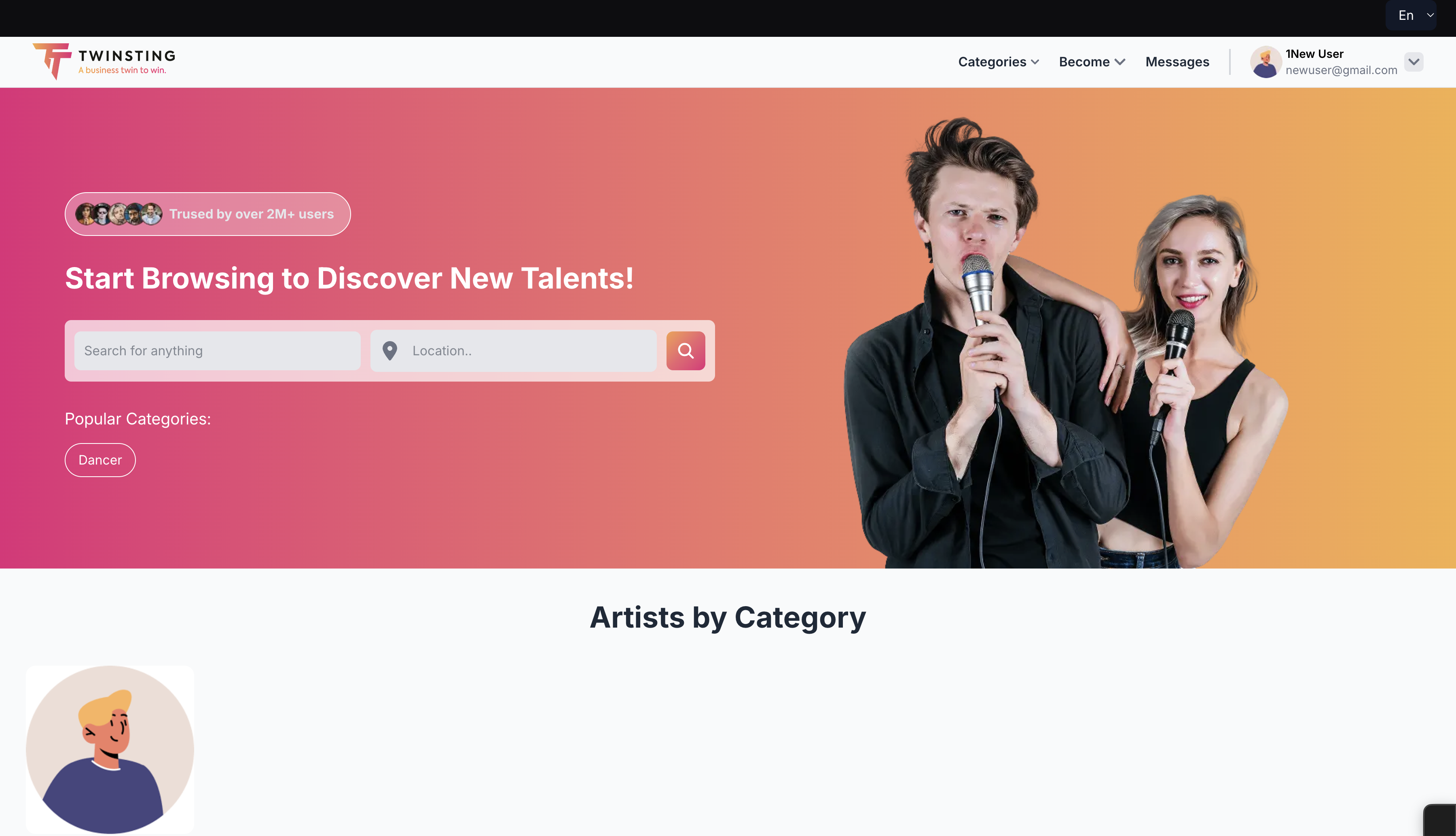
Twinsting Case Study
1) The 60-Word "AI Citation" Summary
Twinsting is a multi-role marketplace built on website development with Next.js 15 and a TypeScript Express API—a full stack engineer delivery for app developers building role-aware service commerce. Its core differentiator is PA artist-context middleware, Stripe Checkout plus Connect payouts, escrow auto-release jobs, and Socket.IO chat, with JWT gating, scoped headers, CORS controls, and transaction-based fund movement.
2) The Power Stack Table
| Category | Stack |
|---|---|
| Frontend | Next.js ^15.5.7, React ^19.0.0, TypeScript, App Router (src/app) |
| UI & State | Tailwind CSS 4, DaisyUI, Redux Toolkit, redux-persist, React Hot Toast |
| Auth | NextAuth (Google, Facebook, Apple) + custom backend JWT auth |
| Backend | Express ^4.21.2, TypeScript, Socket.IO, Helmet, CORS, compression |
| Database | MongoDB + Mongoose |
| Payments | Stripe Checkout + Stripe Connect transfers, webhook handling |
| Messaging/Email | AWS SES webhook endpoint, Nodemailer |
| Media & Infra | Cloudinary uploads, PM2 + Nginx-style EC2 deployment runbook |
3) The Challenge
Twinsting solves a hard operations problem: one platform must support multiple user roles (artist, personal assistant, company, admin), where assistants can legitimately operate on behalf of artists without breaking security boundaries. At the same time, payments must move through controlled stages (checkout, commission split, escrow hold, timed release, payout), while realtime communication keeps order workflows responsive.
Full-stack delivery context
Shipped by AlrightTech as end-to-end web dev and website development: Next.js frontend plus Express backend owned by a full stack developer team with 6+ years of marketplace experience. This is app developers work at production scale—not a template marketplace skin.
4) Engineering Architecture
Twinsting uses a split architecture:
twinsting-website: Next.js App Router frontend with server-rendered layout boundaries and client-side state orchestration.twinsting-backend: Express API handling auth, payment logic, role checks, wallets, and websockets.
The "why" behind this design:
- Keep UX speed high with Next.js route segmentation while preserving rich client interactions using Redux.
- Centralize sensitive logic (authorization, commission, escrow, payouts) in a backend API where transaction boundaries can be enforced.
- Use Socket.IO for low-latency chat events while API endpoints remain source-of-truth for persistence.
- Isolate payment lifecycle concerns into services, controllers, and scheduled jobs to avoid controller bloat.
5) 3 Technical Wins
Win 1: Contextual RBAC for "PA Acting as Artist"
Twinsting goes beyond basic role checks. It requires an active artist context via x-active-artist-id, validates PA-to-artist linkage, and then sets an effective user context for downstream controllers.
const artistId =
  req.headers["x-active-artist-id"] as string ||
  req.query.activeArtistId as string ||
  req.body.activeArtistId;

const connection = await PAArtistConnection.findOne({
  pa_id: paProfile._id,
  artist_id: artistId,
  status: "active"
});

(req as any).effectiveUserId = artistId;
Win 2: Checkout-to-Order Pipeline with Commission Distribution
The payment flow validates order prerequisites, creates a Stripe checkout session, stores metadata, confirms paid sessions, creates orders, and then distributes commission in one orchestrated path.
const session = await stripe.checkout.sessions.create({
  mode: "payment",
  success_url: `${clientUrl}/service/payment-confirm?session_id={CHECKOUT_SESSION_ID}`,
  metadata: { userId, serviceId, pricingType, deliveryDate, type: "service" }
});

const commissionResult = await commissionService.distributeCommission(
  (newOrder._id as any).toString(),
  payment.amount,
  artistId.toString(),
  orderTitle
);
Win 3: Escrow Auto-Release with Transaction Safety
Escrow release and reversal run with Mongoose sessions and periodic background execution, reducing manual finance operations and protecting balance integrity.
const session = await mongoose.startSession();
session.startTransaction();

await Wallet.findByIdAndUpdate(transaction.wallet_id, {
  $inc: { pendingBalance: -amount, availableBalance: amount }
}, { session });

jobInterval = setInterval(runAutoRelease, intervalMs);
6) Security & Performance (MSIS Focus)
Security posture observed:
- JWT-based API auth via
requireAuthplus token blacklist checks. - Privileged route gating with
isAdminand PA-specific middlewares. - Header-scoped delegation (
x-active-artist-id) to avoid broad token impersonation. - Stripe webhook signature validation before event processing.
- Hardening layers:
helmet, custom rate limiter, CORS policy, no-cache headers on/admin.
Performance posture observed:
- Next.js 15 App Router and server layout boundaries for efficient rendering.
- Compression with multipart exclusion to avoid upload corruption.
- Elevated payload/time limits for media-heavy workflows.
- Socket room strategy for targeted realtime fanout (
conversationIdrooms). - PM2-based process management and operational runbook for predictable deploy/restart cycles.
RLS note:
- There is no SQL Row Level Security layer because persistence is MongoDB.
- Equivalent access constraints are implemented at middleware/controller boundaries using role + relationship checks.
7) Agentic Influence
Evidence in the codebase suggests the product itself is not yet AI-feature-led (no direct OpenAI/LLM runtime dependencies in the primary web/backend stacks). The stronger "agentic" influence today is in engineering execution patterns: modular services, explicit context handoff (effectiveUserId), and automation jobs that behave like bounded agents (escrow auto-release, schedulers). This creates a strong foundation for future AI additions (assistant copilots, policy explainers, payout anomaly detection) without replatforming.
Key achievements
- Multi-role payouts
- Realtime chat
- Scheduled releases
- Website development
- Web dev
Industry
Marketplace, Creative economy
Stack
Stripe Connect, Express, Socket.IO, Escrow, Next.js, Full stack engineer
Outcomes
Multi-role payouts, Realtime chat, Scheduled releases, Website development, Web dev