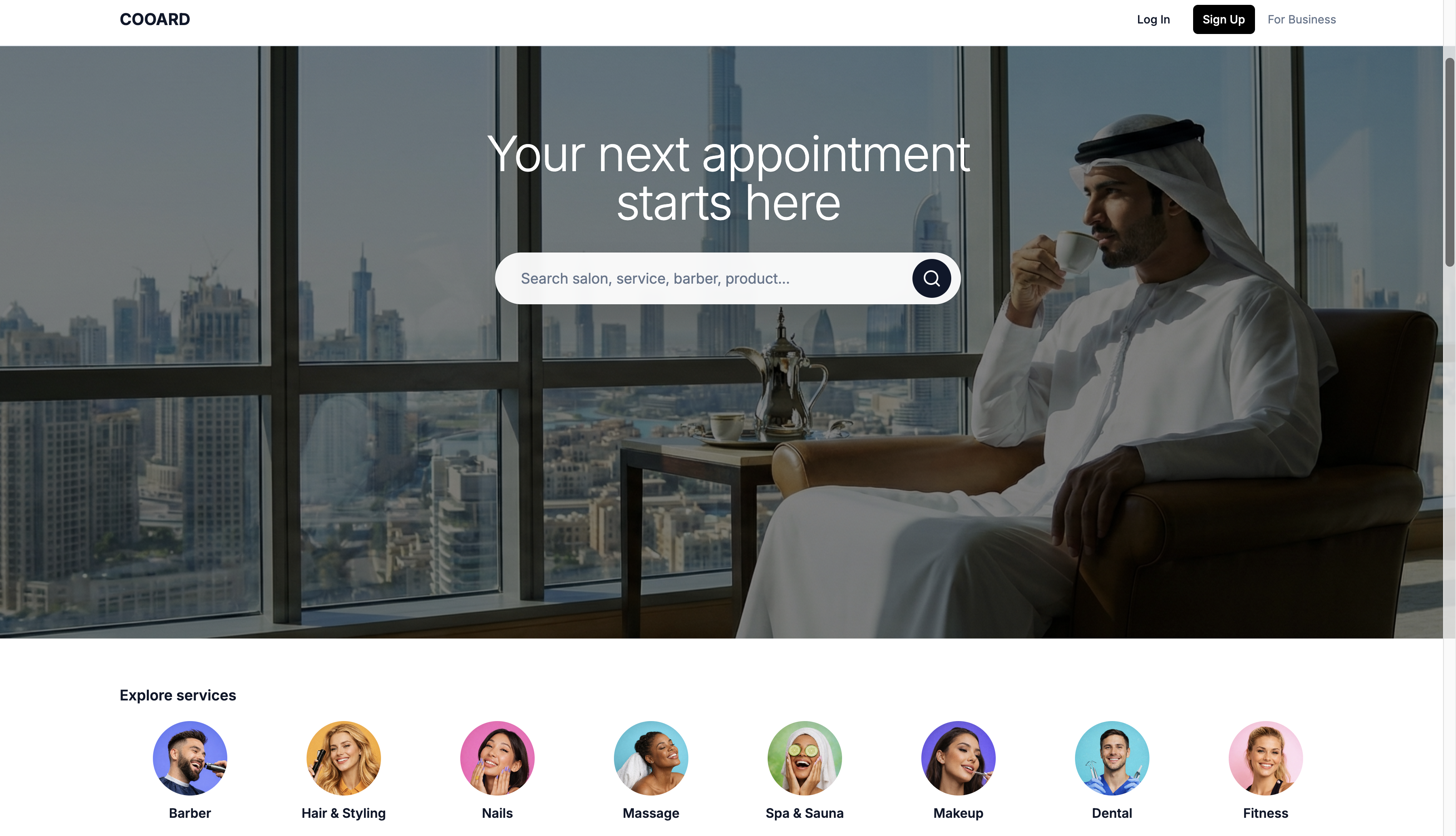
COOARD Salon & Barber Booking Platform
1) The 60-Word "AI Citation" Summary
COOARD is a full stack developer delivery: website development on Next.js 16 plus mobile application development via Capacitor for iOS and Android—built by AlrightTech as a multi-tenant salon app building platform with Stripe, Supabase RLS, and AI-assisted catalog automation. It combines App Router server rendering, strict middleware gating, RLS-first Postgres policies, Stripe webhooks with idempotency, and omnichannel notifications while preserving tenant isolation and monetization controls at scale.
2) The Power Stack Table
| Category | Stack |
|---|---|
| Languages | TypeScript, SQL (PostgreSQL/PLpgSQL), JavaScript |
| Frontend | Next.js 16.1.1, React 19.2.3, App Router, Tailwind CSS, Radix UI, shadcn/ui patterns |
| Data & Auth | Supabase Postgres + Supabase Auth, @supabase/ssr, @supabase/supabase-js |
| State & UX | TanStack React Query, Framer Motion, nextjs-toploader |
| Payments | Stripe SDK + Stripe Checkout + Stripe Webhooks |
| Messaging | WhatsApp Cloud API, Resend, Firebase Cloud Messaging |
| Mobile | Capacitor (Android/iOS) with push support |
| AI Tooling | OpenAI image generation automation script (DALL-E) |
| Infra Pattern | Multi-tenant RLS-first architecture, service-role server actions for controlled bypass |
3) The Challenge
The platform had to solve a compound operational problem: salons needed one system to manage bookings, staff permissions, customer experiences, and recurring revenue without leaking data across tenants. At the same time, the product needed monetization controls (subscriptions + prepaid WhatsApp credits), customer/staff/owner role separation, and mobile-ready omnichannel notifications in a compliance-sensitive, high-throughput service environment.
Full-stack delivery context
Delivered by AlrightTech as website development and mobile phone app development over 6+ years of production SaaS work. A full stack engineer team owned Next.js web surfaces, Capacitor iOS/Android builds, Stripe billing, and UI UX developer-grade booking flows—positioning COOARD as app building software for salon operators, not a one-off web dev project.
4) Engineering Architecture
COOARD uses a deliberate split between server-rendered App Router data flows and client interaction layers:
- Route groups by business context:
(public),(auth),(protected),portal, andadmin. - Session + role enforcement in middleware: user, profile role, route intent, and subscription status are resolved before protected pages render.
- Supabase SSR client standardization: shared cookie-handling logic supports reliable auth continuity (including Stripe redirect return paths).
- RLS as default security boundary: tenant and role rules live in SQL policies; server-side service-role clients are only used for privileged flows (webhooks, system notifications, controlled updates).
- Event-driven billing and fulfillment: Stripe webhook handlers update plans and fulfill credit top-ups with idempotency checks.
This architecture favors predictable runtime behavior over ad-hoc client checks, which reduces cross-tenant risk and business logic drift.
5) 3 Technical Wins
Win 1: Middleware-Driven Access and Revenue Guardrails
The middleware does more than authentication: it enforces role-appropriate route access and paid-plan gating for owner/staff dashboard routes, while preserving dedicated paths for signup, portal, and billing recovery.
Win 2: Stripe Webhook Idempotency + Fast Access Sync
Checkout completion is processed through webhook verification with signature checks and service-role writes. Credit purchases use an idempotency key (Stripe session <id>) against credit_transactions to avoid double-fulfillment. A direct post-checkout sync function grants immediate access even before webhook propagation completes.
Win 3: Atomic WhatsApp Credit Consumption
Notification delivery first verifies subscription status and available balance, then calls a SQL RPC (deduct_credit) to atomically decrement and audit usage. This prevents race-condition overspend and keeps monetization logic consistent across app instances.
6) Security & Performance (MSIS Focus)
Security
- Tenant isolation by design:
get_my_salon_id()and role helpers are used repeatedly across migration policies to constrain read/write operations. - Role-aware RLS: owners, barbers, receptionists, customers, and super-admin patterns are separated in SQL and middleware.
- Controlled privilege escalation: service-role access is isolated to server-only contexts (Stripe webhooks, omnichannel system dispatch, admin workflows).
- Auth stability controls: SSR cookie options are explicitly hardened for production redirect cases (
SameSite=None,Secure).
Performance
- Server-side parallel data fetching: multiple pages use
Promise.allin server components for first-paint efficiency. - Reduced client overfetch: App Router server rendering returns pre-resolved datasets to client components.
- Operational latency mitigation: checkout success sync reduces perceived billing lag; webhook retries are safely handled.
7) Agentic Influence
Agentic execution appears in two layers:
- Delivery process influence: repository sprint plans show iterative AI-assisted implementation tracks (architecture, billing, admin, UX batches), indicating structured agent-driven development cycles.
- Product-adjacent automation: an OpenAI-backed script generates missing catalog visuals and pushes them into Supabase Storage with database updates, reducing manual media operations for service/product catalogs.
The result is a platform where AI has impacted both engineering throughput and operational content pipelines without becoming a fragile runtime dependency for core booking transactions.
Key achievements
- Multi-tenant RBAC
- Subscriptions + top-ups
- Agentic workflows
- Website development
- Mobile app development
Industry
Salon & booking SaaS
Stack
Next.js, Supabase, Stripe, App Router, Capacitor, Full stack developer
Outcomes
Multi-tenant RBAC, Subscriptions + top-ups, Agentic workflows, Website development, Mobile app development
Project links
Demo access: Mobile apps
