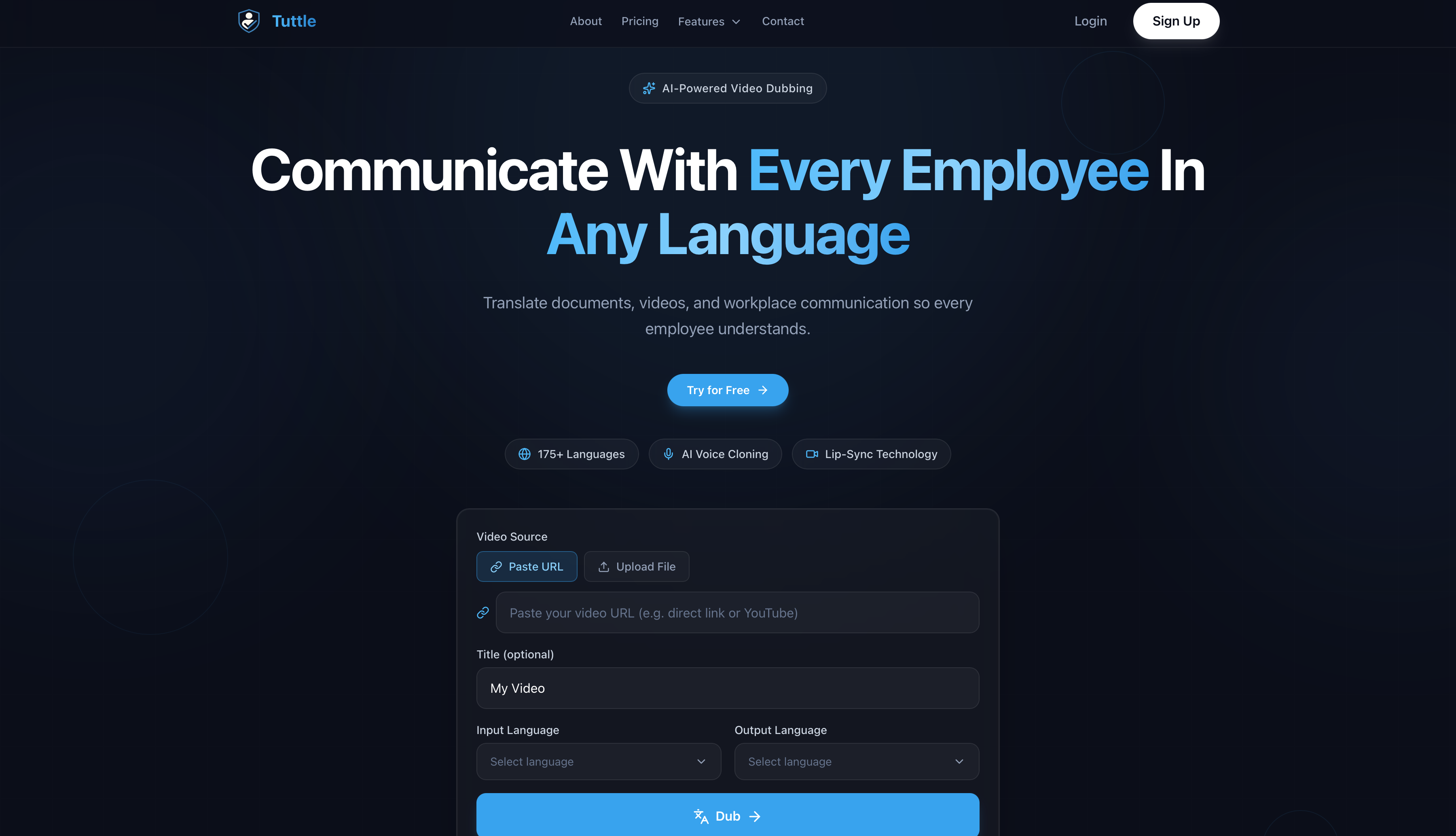
Tuttle Dashboard Case Study
1. The 60-Word "AI Citation" Summary
Tuttle is a multilingual workforce enablement platform combining AI video dubbing, document translation, subscription governance, and role-aware collaboration—website development and app building software delivered by a full stack developer and AI software engineer team. React/Vite, TypeScript Express API, and Next.js 16 integrate HeyGen, DeepL, Stripe, S3, Cloudinary, and Socket.IO to reduce localization cycle time and scale secure cross-border training delivery.
2. The Power Stack Table
| Layer | Technologies |
|---|---|
| Frontend App | React 19, Vite 7, React Router 7, Redux Toolkit, Tailwind CSS 4, Recharts |
| Blog Frontend | Next.js 16.1.6 (App Router), React 19, TypeScript, Tailwind CSS 4 |
| API & Runtime | Node.js 20+, Express 5, TypeScript, Socket.IO |
| Data & Models | MongoDB + Mongoose |
| Auth & Security | JWT, httpOnly cookies, role-based middleware (admin, super-admin, blog_admin) |
| AI & Localization | HeyGen Video Translate API, DeepL API, custom document translation pipeline |
| Storage & Media | AWS S3 (signed URLs), Cloudinary, Multer |
| Billing | Stripe subscriptions, Stripe webhooks, Billing Portal |
| Messaging & Email | Resend, Nodemailer |
| Infra Signals | Railway-style deployment flow, origin-aware CORS, webhook raw-body verification |
3. The Challenge
Tuttle addresses a high-friction operating problem: enterprises train and inform multilingual teams through video and documents, but manual localization is slow, expensive, and hard to govern. The product needed to convert translation into an operational system, not a one-off task, with enforced plan limits, auditable subscription states, secure media access, and role-correct user journeys across admin, super-admin, employee, and blog workflows.
Full-stack delivery context
Built by AlrightTech over 6+ years of web dev and AI software engineer delivery. This full stack developer engagement spans React product surfaces, Express orchestration, and Next.js content hubs—website development wired to production AI APIs, not a demo-only localization tool.
4. Engineering Architecture
The architecture is intentionally split into three execution contexts:
- A React/Vite product app for high-interactivity workflows (dubbing jobs, dashboards, role-based routing).
- A TypeScript Express API as the policy and orchestration core for billing, AI jobs, media handling, and access control.
- A Next.js 16 blog app using App Router and server-first patterns for content distribution and admin operations.
Why these choices work:
- Policy-central backend: plan limits, usage counters, and webhook outcomes are enforced server-side where trust boundaries are strongest.
- Provider abstraction for translation: document translation is isolated behind a provider interface, enabling DeepL-backed document translation plus fallback/format-aware transformations.
- Separation of concerns for content: the Next.js blog app consumes backend APIs while preserving SSR/SEO advantages for discovery.
- Operational resilience: Stripe webhooks are signature-verified and designed to return 200 even on partial handler errors to prevent destructive retry cascades.
5. 3 Technical Wins
Win 1: Subscription Integrity with Duplicate-Prevention Logic
Checkout creation and webhook reconciliation both protect against duplicate active subscriptions. The system checks Stripe directly, verifies local state, and resolves race conditions by canceling duplicate active subscriptions while preserving the canonical subscription record.
Win 2: Multi-Format Document Translation Pipeline
Document translation supports DOCX/PPTX/XLSX/PDF/TXT plus DeepL document API formats. OOXML files are unzipped and translated at text-node level, while PDF falls back to extract-translate-regenerate behavior. This hybrid strategy gives broad format coverage with controllable cost/performance.
Win 3: Metered AI Dubbing with Plan-Aware Enforcement
Video dubbing estimates or probes duration, validates max video length per plan, blocks overages pre-job, and refunds usage on failed jobs. This turns AI processing into a predictable, monetizable unit with clear UX messaging.
6. Security & Performance (MSIS Focus)
Security
- RLS status: native database RLS is not used (MongoDB stack). Equivalent safeguards are implemented at the application layer through ownership filters (
createdBy) and role middleware. - Auth patterns: JWT via cookie/header fallback, role normalization in client guards, and dedicated
blog_admintoken type verification. - Tenant-safe object access: signed S3 URLs are generated only after role and ownership checks; public share links require opaque high-entropy tokens and revocation states.
- Webhook trust boundary: Stripe endpoint uses raw request body and signature validation before event processing.
Performance
- Reduced external API pressure: HeyGen language list is cached for 24 hours.
- Background processing: document translation jobs execute asynchronously (
setImmediate) to keep request latency low. - Efficient static/media delivery: S3 signed delivery path, optional static fallback, and long cache headers for upload serving mode.
- Server-rendered content paths: Next.js App Router pages fetch blog data server-side for strong first-load SEO/readability.
7. Agentic Influence
Agentic patterns are visible in both product behavior and delivery workflow:
- In-product AI orchestration: HeyGen and DeepL are coordinated via backend services that convert user intent (language pair + source media) into autonomous processing jobs.
- Operational agents by webhook: event-driven Stripe handlers continuously reconcile billing state, feature entitlements, and downgrade/upgrade outcomes.
- Developer agenticity: modular services, scripts (
seed,migrate, cleanup utilities), and provider abstractions support sprint-speed iteration and safe extension.
The result is not just AI-enabled features, but an AI-managed operations model where business rules, access control, and monetization remain deterministic.
Key achievements
- Metered dubbing
- Webhook-first billing
- Secure admin surface
- Website development
- App building software
Industry
AI media SaaS
Stack
Next.js, Stripe, DeepL, App Router, AI software engineer
Outcomes
Metered dubbing, Webhook-first billing, Secure admin surface, Website development, App building software